
The Phantom Reality of Representationism

by Ken Hamrick

This is an informal discussion of the concluding part of John Murray’s book, The Imputation of Adam’s Sin, (Phillipsburg, NJ: Wm. B. Eerdman, 1959). As a Realist, I disagree with Murray’s Representationist view (which is also a Nominalistic Federal view).

Realism is the biblical principle of a shared identity grounded in a spiritual union or singularity of spiritual origin–and more broadly, Realism is a paradigm in which God’s justice depends on substantial reality; whereas Nominalism is the denial of any identifying union of immaterial substance within the man, Adam–and more broadly, it is a paradigm in which substantial reality is not necessary to God’s justice. Realists, from their paradigm, seek a justice that is commensurate with the facts of substantial reality and find it in a real union of immaterial substance inside Adam; whereas Nominalists see no necessity for justice to be dependent on the facts of substantial reality, but instead, include the nonsubstantial thoughts of God as sufficient ground for justice, and so they are content to locate man’s union with Adam as inside God’s mind alone.

Continue reading “The Phantom Reality of Representationism”

The Image of God

by Ken Hamrick

Of all the creatures. Man alone is a spiritual being. Man and all other creatures have bodies, but only man has a spirit. It is significant that God, inspiring His inerrant, written word, chose to call the immaterial nature in man a spirit, which is the same word He chose to describe His own nature –John 4:24, “God is Spirit, and they that worship Him must worship Him in spirit and in truth.” Every functional similarity of God in man that has been labeled as the image of God, such as man’s moral nature, his relationality, his dominion over the other creatures, and his reason and rationality, his personhood, etc., are only possible because man is a spiritual being. Without his own spirit, man could function in none of these ways. Because man is a spiritual being, he is a person. Only spiritual beings are persons. Animals without spirits can never be persons and men can never lose their personhood. Men are innately moral beings because they are spiritual beings.

There is another aspect of the image of God to be considered. There is a real sense in which what we gain in Christ we lost in Adam. We are spiritually resurrected—brought to life spiritually—when we are saved by Christ. Prior to salvation, we were spiritually dead—alienated from God and without the Spirit of God inside us. God sends the Spirit of His Son into our hearts, crying, ‘Abba! Father!’ I suggest that Adam was created not only as a spiritual being, but also in spiritual union with the Holy Spirit inside him. As he chose to sin, the Holy Spirit left him and he spiritually died. Spiritual death is disunion with the Spirit of God who is the only Source of spiritual life.

Continue reading “The Image of God”

A Realist’s Review of Calvin on Osiander

by Ken Hamrick

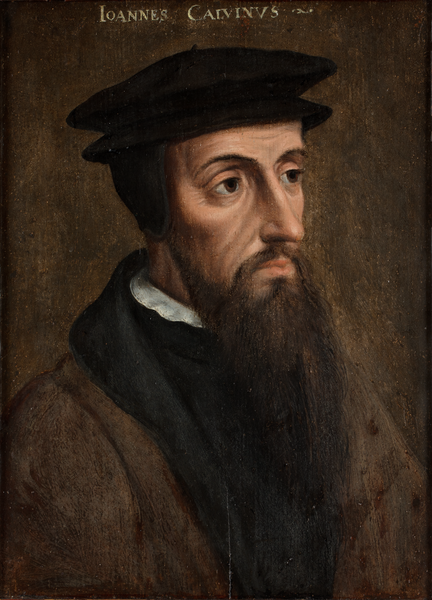
John Calvin

John Calvin devoted an entire chapter of his Institutes[1] to refuting Andreas Osiander.[2] Osiander, a Lutheran theologian and professor at Königsberg University, stirred up quite a controversy in the 1550’s by teaching that men are justified neither by “mere imputation” nor by the human righteousness of Christ, but only by His “essential” (divine) righteousness, which becomes ours through a substantial union with the divine nature.[3] Calvin calls this a “monstrosity” and a “delerious dream”[4] and has much to say about it.

Calvin states, “[…]a man will be justified by faith when, excluded from the righteousness of works, he by faith lays hold of the righteousness of Christ, and clothed in it appears in the sight of God not as a sinner, but as righteous.” As a proponent of the consistent Realist view,[5] I must point out that we are clothed not merely with the righteousness of Christ, but with Christ Himself (Rom. 13:14). Realism sees the need for justice and moral union to be grounded in a real union of being. Osiander seems to have had this truth in view, but missed the mark badly by discounting Christ’s human righteousness and denying the unity of Christ’s natures in redeeming us.

Continue reading “A Realist’s Review of Calvin on Osiander”

Osiander’s Error & Realism’s Truth

by Ken Hamrick

Andreas Osiander
Andreas Osiander

A consistently realistic system of theology is one in which a parallel is found between our realistic union with Adam and our realistic union with Christ–the former being the ground of justice for our suffering the consequences of Adam’s sin, and the latter being the ground of justice for our being justified and saved by the life, death and resurrection of Christ. That is the position I have sought to put forward as the best understanding of Scripture.[1]

One criticism of the consistent realistic system, which occasionally arises and must be addressed, is that such a system is a rehash of the sixteenth-century error of Andreas Osiander that was universally rejected by the Church. Timothy Wengert has written a very detailed book, entitled, Defending Faith,[2] about the “reactions to and condemnations of [Osiander’s thought by] …Evangelical theologians of all sorts throughout the Holy Roman Empire… for the better part of the 1550’s.”[3]

Continue reading “Osiander’s Error & Realism’s Truth”

Defending Traducianism from Materialism

by Ken Hamrick

The most common, and often the most convincing, objection to traducianism is the argument that traducianism would require a materialistic division of the immaterial substance of the soul. The ironic thing about these objections is that they first assume that propagation of the soul would require a materialistic division…

Continue reading “Defending Traducianism from Materialism”

A Realist’s Response to Robert Strimple

by Ken Hamrick

In a recent discussion with Dr. Lane Tipton and others on the Reformed Forum Discord, I was offered Robert Strimple’s critique of Realism as “the finest… ever heard.” What follows is my informal engagement of that critique, as posted in that discussion.

You can find much of the remainder of that discussion here.

Dr. Robert B. Strimple, Professor of Systematic Theology at Westminster Seminary California, approaches the origin of the soul in the following lecture: https://www.wscal.edu/resource-center/trichotomy-the-origin-of-the-soul-the-covenant-of-works-part-1 beginning at 07:55; He teaches about Realism in two of his lectures: https://www.wscal.edu/resource-center/the-parties-involved-part-2 beginning at 40:20, and continuing with: https://www.wscal.edu/resource-center/the-parties-involved-part-3

Continue reading “A Realist’s Response to Robert Strimple”

Al Mohler the Traducianist

by Ken Hamrick

I was surprised this week to hear Al Mohler take a stand for traducianism—and to explain it in terms that were exclusively paternal.

See 53:14 – 56:20, @ https://na01.safelinks.protection.outlook.com/?url=https%3A%2F%2Fyoutu.be%2F_3T6YoaiMmw&data=05%7C01%7C%7Cc7efcac0c2964c65362608db12e436f2%7C84df9e7fe9f640afb435aaaaaaaaaaaa%7C1%7C0%7C638124543593139726%7CUnknown%7CTWFpbGZsb3d8eyJWIjoiMC4wLjAwMDAiLCJQIjoiV2luMzIiLCJBTiI6Ik1haWwiLCJXVCI6Mn0%3D%7C3000%7C%7C%7C&sdata=r0xz2PZ538UqSSVh63faUiNAlE%2FF0TGcSH6xxHHTyiY%3D&reserved=0

Continue reading “Al Mohler the Traducianist”

A Realist’s Review of J.V. Fesko’s ‘Death in Adam, Life in Christ,’ Part 2

by Ken Hamrick

Continuing from Part 1

Fesko’s misrepresentations are disturbing. As I read his section on Augustine[23], I thought maybe he had misunderstood Augustine when Fesko claimed that Realism was about a “biological” union in Adamthat Realism claimed a physical presence of all men in Adam.

However, after Fesko described the views of Shedd and Baird (the Realist School of the 19th century), and showed that he does indeed understand that the view is about the propagation of the soul and the “co-agency” of all men while in Adam[24], he continues for the remainder of the book to refer to Realism as “biological” and “physical transmission”not as additional to “spiritual” or “immaterial transmission” (which he ignores) but as if “physical” and “biological” accurately described the Realistic view. Misunderstanding Augustine might be excusable, but continuing the error even after showing a basic understanding of Shedd and Baird is inexcusable! Fesko says,

Continue reading “A Realist’s Review of J.V. Fesko’s ‘Death in Adam, Life in Christ,’ Part 2”

A Realist’s Review of J.V. Fesko’s ‘Death in Adam, Life in Christ,’ Part 1

by Ken Hamrick

J. V. Fesko is Academic Dean and Professor of Systematic and Historical Theology at Westminster Seminary in California, and has written many books. I found this book[1] to be substantive and thought provoking. It is well worth the reading—and I think it demands a response.

Fesko writes in the preface, “[…T]here are few, if any, books that treat both imputed guilt and righteousness. When it came to the history of the doctrine of imputation, there are hardly any monographs that treat the doctrine.” Fesko is a proponent of the modern Reformed view of Covenant (or, Federal) Theology, and defends that view against the main alternatives, historical and contemporary—including the Realistic view. While it is not his main purpose to engage the Realistic view, it is my main purpose in this article to address his engagement of that view, which I have found to be lacking.

Continue reading “A Realist’s Review of J.V. Fesko’s ‘Death in Adam, Life in Christ,’ Part 1”